

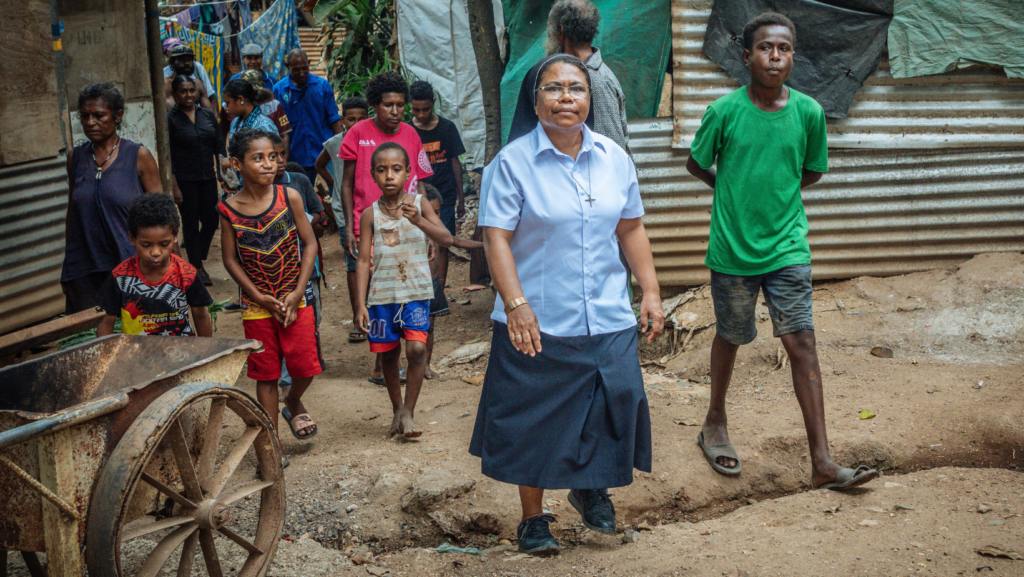
Meet Sr Daisy – Religious Sister and Media Professional. As Head of Communications for the Bishops’ Conference of Papua New Guinea and the Solomon Islands, she has been witness to some profound changes within the Church and in her homeland.
There was a minor sensation that Sr Daisy was appointed Head of Communications for the Bishops’ Conference of Papua New Guinea and the Solomon Islands two years ago. She is both the first local and the first woman to be appointed to this role. And this lively Sacred Heart Missionary is clearly passionate about communication – as she puts it: ‘one of the most important tasks in the Church’.
‘I like my work because I can inform people about the truth when I report on victims of violence, internally displaced persons, or the resistance to deep-sea mining… I want to show the world the realities that affect the lives of ordinary people.’
Along with her team, this 47-year-old publishes the newspaper The Catholic Reporter. Other publications, social media channels, television and radio stations are also being added. Radio plays a particularly important role because it reaches many people who cannot read throughout this region.
Finding her path
It wasn’t preordained that Sr Daisy would pursue a career in journalism. She comes from one of the country’s southern provinces and from a humble background. After graduating from school, she decided to enter the Order and originally worked as a teacher.
Later, Sr Daisy moved to the Communications Department of the Archdiocese of Rabaul. There she witnessed the diocese’s fight against a foreign corporation that was recklessly cutting down trees and encroaching on the sacred sites of village communities.
A pivotal moment
With her cell phone, Sr Daisy filmed the deportation of a New Zealand lay missionary who had fought for the rights of the local population. She recalls:
‘I posted the video on Facebook. It went viral. News agencies from all over the world reported on it.’
This was a pivotal moment for her. At the age of 40, she decided to try something new and studied journalism in Manila with the support of Missio. Afterwards, the Bishops’ Conference appointed her to head the Communications Department. ‘I want to show the world the realities that affect the lives of ordinary people,’ she shared in an interview with Vatican News.
A Vatican ‘first’
Then in May 2023, a truly remarkable visit took place. Sr Daisy was invited to accompany the bishops for the ad limina visit of the Bishops of Papua New Guinea and Solomon Islands. Noticing her, Pope Francis invited her to take part in the audience, which is usually reserved only for bishops. ‘It had never happened before,’ Sr Daisy said. She added that the occasion:
‘Gave me hope that Pope Francis appreciates the work that women do in the Church. He shows total discipleship, total leadership of a servant leader who embraces everyone.’
Watch Sr Daisy describe the occasion in this film from Vatican News:
A visit from Pope Francis
For Sr Daisy, the late Pope Francis’ visit to Papua New Guinea was a very special event. She had been heading communications for the Bishops’ Conference of Papua New Guinea and the Solomon Islands for two years by then; the first native and the first woman to hold this position.
This is no easy task in a country where almost all leading positions in politics and society are held by men. She shares:
‘For me as a nun, the Pope’s visit was an extraordinary experience, especially with regard to the media. In Papua New Guinea, we still have our “big-man system”. The Pope’s hopeful and compassionate messages challenge the status quo and ensure that women are recognised for the contributions they make to the Church.’
Changing minds and messages in Papua New Guinea

What Sr Daisy terms the ‘big man system’ is no joke in Papua New Guinea and the Solomon Islands, where women are often excluded and discriminated against. According to the United Nations, women are 29% less likely to have access to financial services, to positions of influence and to education.
Social norms and traditions also often harm or limit women’s agency and opportunities, and Papua New Guinea has one of the highest rates of gender-based violence in the world outside a conflict zone.
